Tadcaster Inn
The Man Who LaughsThe Tadcaster Inn is a rare fixed landmark in a fairground landscape built around temporary caravans. Its enclosed courtyard becomes an improvised theatre for Ursus’s troupe, while its doors and taproom provide the route through which the law removes Gwynplaine from that world. The inn thus joins two sharply different forms of public display: performance arranged for an audience and a silent arrest conducted under the authority of a constable’s staff.
Setting and Access
Named after the former owners of the ground, the Tadcaster is described as more than a simple tavern: it has the scale of an inn or hotel, with a carriage entrance and a large yard. Against the surrounding mountebanks’ rootless life, in which the caravans can disappear at any moment, it is the bowling-green’s sole dwelling. The contrast makes the building a fixed point within a setting otherwise defined by mobility.
The main carriage entrance, opening from the field into the courtyard, is the inn’s formal entrance, but it remains barred and bolted. People instead use a smaller side door, which leads directly into the tavern. Because the yard can only be reached by crossing the tavern, even arrival at the courtyard entails passing through this low-ceilinged, smoke-filled taproom, furnished with tables. The arrangement makes the interior a threshold between the public field and the enclosed space where the troupe sets up its theatre.
The Courtyard as Theatre
Ursus is attracted to the yard because it seems made for the Green Box. The space is square, enclosed on three sides by the house and on the fourth by a wall. The troupe can draw the Green Box through the high gate and place it against that wall, turning the courtyard into an improvised playhouse.
The building itself supplies the audience’s tiers. A roofed wooden balcony runs around three sides of the upper façade, while the ground-floor windows serve as boxes, the paving as the pit, and the balcony as the gallery. With the Green Box raised against the fourth wall, the yard faces it like a stage. The narrator compares the arrangement to the Globe, associated with performances of Othello, King Lear, and The Tempest. A stable occupies a corner behind the Green Box, a practical reminder that this theatre remains embedded in an inn yard rather than separated from everyday use.
Ursus has arranged the space with the tavern keeper, Master Nicless. The agreement includes a small but revealing condition: out of respect for the law, Nicless will admit the wolf only for an additional charge. The theatrical household and its animal performer are accommodated within ordinary commercial and legal arrangements, even as the yard is transformed into a venue.
Gwynplaine’s Arrest
The inn’s passages acquire a different significance when a hooded official appears in the doorway behind Dea. He wears black, has a wig drawn down to his eyebrows, and carries a short, heavy iron staff with a crown at each end. Ursus recognizes the figure as the wapentake and warns Gwynplaine in a whisper. The arrival of the staff-bearing officer turns the familiar interior into the setting for an exercise of authority.
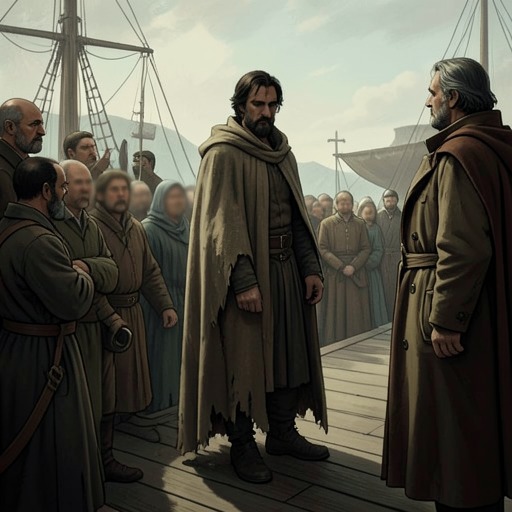
The departure is conducted without public explanation. The wapentake leads Gwynplaine across the yard and through the dark taproom, never turning to look at him. Outside, a justice of the quorum waits with a squad of police. Passers-by gather at the inn door, then silently make way at the sight of the constable’s staff. Gwynplaine walks between the officers in two ranks, wrapped in his cloak like a shroud, as the group proceeds toward the narrow street beside the Thames. The sequence carries him from the troupe’s enclosed base into custody through the same spaces that had connected the field to its improvised theatre.
Narrative Significance
The Tadcaster’s courtyard makes theatrical space out of an inn’s ordinary architecture: a wall becomes the backdrop, the windows and balcony become seating, and the paving becomes the pit. That conversion belongs to the itinerant troupe’s world, where a performance space can be assembled inside a place whose inhabitants have no lasting roots. Yet the inn is not a refuge from the institutions beyond it. Its tavern and yard remain accessible to officials, and the arrest crosses them with the same matter-of-fact precision as the troupe’s movement through its makeshift theatre.
The location therefore holds both the promise and the limit of performance. The Green Box can reorganize the courtyard for an audience, but it cannot prevent the law from reorganizing that same space as a corridor of removal. The sudden passage from domestic threshold to public street marks the break between Gwynplaine’s life among the troupe and his forced entry into another social order.